How a Restaurant POS System Streamlines Daily Operations
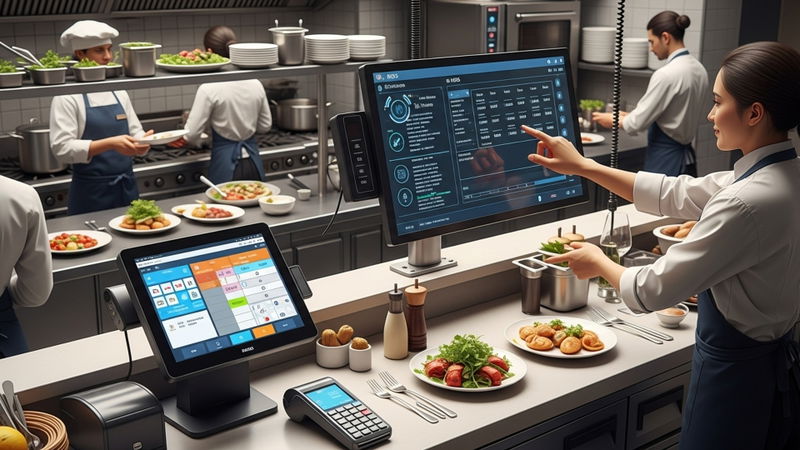
Running a restaurant involves much more than preparing food and serving customers. Restaurant owners and managers have to coordinate orders, kitchen operations, billing, payments, inventory, employees, suppliers, and daily business reports.
When these activities are handled separately, it can create unnecessary work and increase the possibility of errors.
A restaurant POS system can help bring many of these operations together in one connected workflow.
From taking orders and generating bills to tracking sales and inventory, modern restaurant POS software can help businesses improve efficiency and gain better visibility into their daily operations.
What Is a Restaurant POS System?
A restaurant POS (Point of Sale) system is software designed to manage sales and other restaurant operations.
A basic POS can handle billing and payments, while a modern restaurant POS system can connect several areas of the business, including:
Order management
Billing
Payments
Inventory
Sales reporting
Employee access
Customer management
Multi-location operations
The main advantage is connectivity.
Instead of maintaining separate records for every process, businesses can create a workflow where information moves from one operation to another.
1. Faster Order Management
Taking orders accurately is one of the first steps toward efficient restaurant operations.
A restaurant POS system can allow staff to enter orders directly into the system instead of relying entirely on handwritten notes.
Depending on the restaurant's setup, orders can then be sent to the appropriate kitchen printer or display.
This can help staff:
Reduce order-entry mistakes
Communicate orders faster
Track open orders
Manage table orders
Handle modifications more clearly
2. Simplifies Restaurant Billing
Billing can become complicated when restaurants have multiple items, discounts, taxes, split bills, or different payment methods.
A restaurant POS can automate many of these calculations.
For example:
Order → Bill → Tax/Discount → Final Amount → Payment
This can reduce repetitive manual calculations and help employees process customers faster.
3. Connects Sales With Inventory
Inventory management is one of the biggest challenges for restaurants.
Restaurants purchase ingredients, use them to prepare dishes, and sell those dishes throughout the day.
A POS connected with inventory management can help track the relationship between sales and stock movement.
For example:
Dish Sold → Inventory Consumption → Stock Update
The exact inventory deduction depends on how products, recipes, and stock rules are configured in the system.
This can help restaurant owners maintain better visibility into inventory.
4. Helps Reduce Food Waste
Food waste can directly affect restaurant profitability.
Ingredients can be wasted because of:
Over-ordering
Spoilage
Expiry
Overproduction
Preparation mistakes
Poor storage
A restaurant inventory system can help owners monitor stock levels and identify products that require attention.
Sales data can also help businesses estimate demand more accurately and improve purchasing decisions.
5. Makes Payments More Organized
Modern restaurants may accept cash, UPI, debit cards, credit cards, and other payment methods.
A POS system can record payment information along with each transaction.
This can make it easier to review:
Total sales
Cash collections
Digital payments
Card payments
Refunds
Discounts
This information can also support end-of-day reconciliation.
6. Provides Useful Sales Reports
Restaurant owners need more than a total sales number.
They may want to know:
Which dishes are selling the most?
What are the busiest hours?
Which products are slow-moving?
How much did the restaurant sell today?
How are sales changing over time?
A modern restaurant POS system can provide reports that help answer these questions.
Using actual sales data can help restaurant owners make more informed decisions about menus, purchasing, staffing, and promotions.
7. Improves Employee Management
Restaurant employees may have different responsibilities.
Cashiers, servers, managers, and other staff members may not need access to the same POS functions.
User roles and permissions can help restaurant owners control access to different parts of the system.
This can also make it easier to track activity and maintain operational accountability.
8. Helps Manage Tables and Orders
For dine-in restaurants, table management can become challenging during busy periods.
A POS system can help employees keep track of:
Occupied tables
Open orders
Pending bills
Table transfers
Split bills
This can make the front-of-house operation more organized.
9. Supports Better Purchasing Decisions
Restaurant purchasing should be based on demand rather than guesswork.
Sales and inventory data can help owners identify which ingredients and products are being used most frequently.
For example, if sales data shows that a particular dish consistently performs well, the restaurant can plan its ingredient purchases accordingly.
This can help balance availability with the risk of excessive inventory.
10. Makes Multi-Location Management Easier
Restaurant businesses with multiple branches have additional operational challenges.
Owners may need to compare sales and inventory across different locations.
Depending on the POS platform, centralized reporting can help monitor:
Branch sales
Inventory
Product performance
Payments
Business reports
This can provide owners with a broader view of the business.
11. Reduces Duplicate Data Entry
One of the biggest advantages of an integrated POS system is reducing repetitive work.
Without an integrated system, employees may have to enter the same information into multiple records.
With a connected POS workflow, information can move through different processes automatically.
For example:
Order → Billing → Payment → Sales Report → Inventory Update
Less duplicate entry can mean less administrative work and fewer opportunities for data-entry mistakes.
12. Helps Improve Customer Experience
Technology should ultimately improve the customer's experience.
A well-configured POS system can contribute to:
Faster ordering
Faster billing
More accurate orders
Convenient payment options
Shorter waiting times
Smoother table management
Customers may never notice the POS itself, but they can notice the operational improvements it enables.
How Reecost Can Support Restaurant Operations
For restaurants looking to bring sales, billing, inventory, payments, and reporting into a connected workflow, Reecost can be considered as a POS solution.
The objective should not simply be to replace a traditional cash register.
A modern restaurant POS should help connect the different processes that happen throughout the day and provide owners with useful business information.
How to Choose a Restaurant POS System
Before selecting restaurant POS software, consider the following:
Ease of Use
Employees should be able to learn the system without extensive training.
Order Management
The system should support the restaurant's ordering and service model.
Billing
Check whether it supports the billing features your restaurant requires.
Inventory Management
Look for inventory capabilities that match your menu, ingredients, and purchasing process.
Payment Options
Make sure the system supports the payment methods your customers commonly use.
Reporting
Choose a system that provides reports that are actually useful for decision-making.
Scalability
If you plan to expand, consider whether the POS can support additional locations and users.
Security
Business and customer information should be protected using appropriate access controls and security practices.
Final Thoughts
A restaurant POS system can do much more than generate bills.
When properly configured, it can connect orders, billing, payments, inventory, employees, and reporting into a more organized workflow.
The result can be less repetitive work, better access to business information, improved inventory visibility, and a smoother customer experience.
For restaurant owners, the goal isn't simply to adopt new technology.
The goal is to use technology to make everyday operations faster, more accurate, more organized, and easier to manage.
That's where a modern restaurant POS system can provide real value.
Comments
No comments yet. Be the first to comment!